When I was younger, I often found myself wishing I could fast-forward time. Sometimes it was because I was looking ahead to something I was excited about, a trip, time with friends, graduation, or some new season of life that felt just out of reach. Other times, it was because I wanted to get through something difficult. Pain, uncertainty, struggle, and waiting all felt like obstacles standing between me and where I wanted to be. I wanted to skip the uncomfortable parts and arrive at the good parts sooner. Looking back now, I understand why I felt that way, but I also see how much I misunderstood.
Time is the greatest gift we have, and it is the one thing we can never reclaim once it is gone. I remember someone once telling me that any aging billionaire would gladly trade every dollar they owned for just a little more time. The older I get, the more I believe that. In many ways, we already see this truth playing out around us. People spend enormous amounts of money trying to extend their lives through medicine, treatments, supplements, and every new technology promising longevity. The anti-aging industry alone is worth hundreds of billions of dollars. That reality says something important to me. What we often spend so casually in youth becomes the most precious thing in the world when we begin to run short of it.
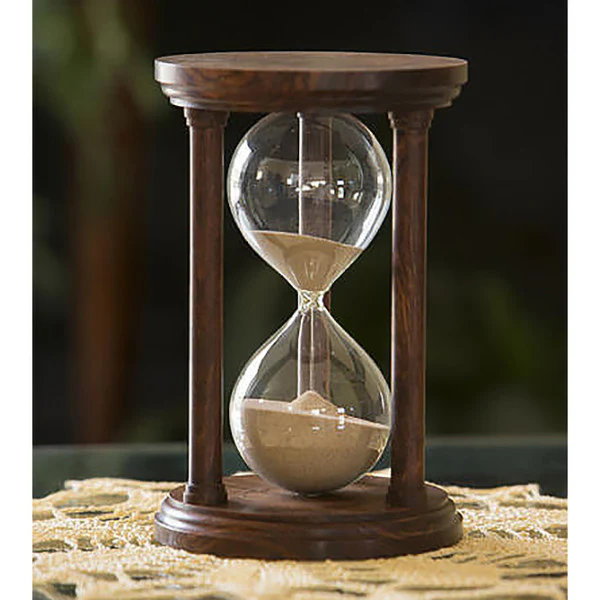
I often talk to my students about this in my Human Growth and Development course. One way I illustrate this concept is with an hourglass. When I hold it in front of the class, I cover the top half with my hand. I tell them that the bottom of the hourglass represents the past. The sand there has already fallen. It is finished. We cannot change it, fix it, or relive it. We can learn from it, but too many people spend far too much time staring at what has already passed, trying to rewrite chapters that are permanently closed. I’ve often thought “trauma work” can focus too much time here.
The top half of the hourglass represents the future, but I keep it hidden because none of us can truly see how much sand remains. We can make educated guesses based on our health, our family history, or statistics, but at best those are only estimates. Life has a way of interrupting our plans. Some people leave this world much sooner than expected, and others stay much longer. The future remains uncertain, no matter how carefully we try to map it out.
What remains, then, is the narrow center of the hourglass, the place where the sand is moving right now. That small space is the present, and it is the only place where life is actually happening. It is where our choices matter. It is where love is expressed, work gets done, healing begins, and memories are made. The present is often overlooked because it feels ordinary, but in reality, it is the only place where we have any power at all.
I have never fully understood boredom because there have always been so many things I want to do. There are books I want to read, ideas I want to explore, things I want to build, conversations I want to have, and goals I still want to move toward. At the end of most days, I like knowing that something, however small, moved forward. Sometimes that progress is tangible, and sometimes it is simply reflection, planning, or thinking through what comes next. Even rest can be an accomplishment when it is what the mind or body truly needs.
At the same time, making the most of the present does not always mean doing more. Sometimes it means noticing more. Lately, I have found myself slowing down enough to pay attention to simple things I once overlooked, like the sound of birds in the morning or the variety of birds I pass each day. I have enjoyed using the Merlin app to identify them, and in doing so, I have been reminded that life is constantly unfolding around us, whether we stop to notice it or not. Nature has a way of grounding us in the present if we allow it.
Maybe that is part of wisdom, learning not just to fill our days, but to really live them. Not to race endlessly toward tomorrow, and not to remain trapped in yesterday, but to stand in the narrow center of the hourglass and recognize that this moment is where life is. Perhaps one of life’s great ironies is that when we are young, we often want to hurry through time, but when we are older, we would give almost anything to slow it down. The challenge, then, is to learn that lesson before too much sand has fallen.
Dr. Wesley