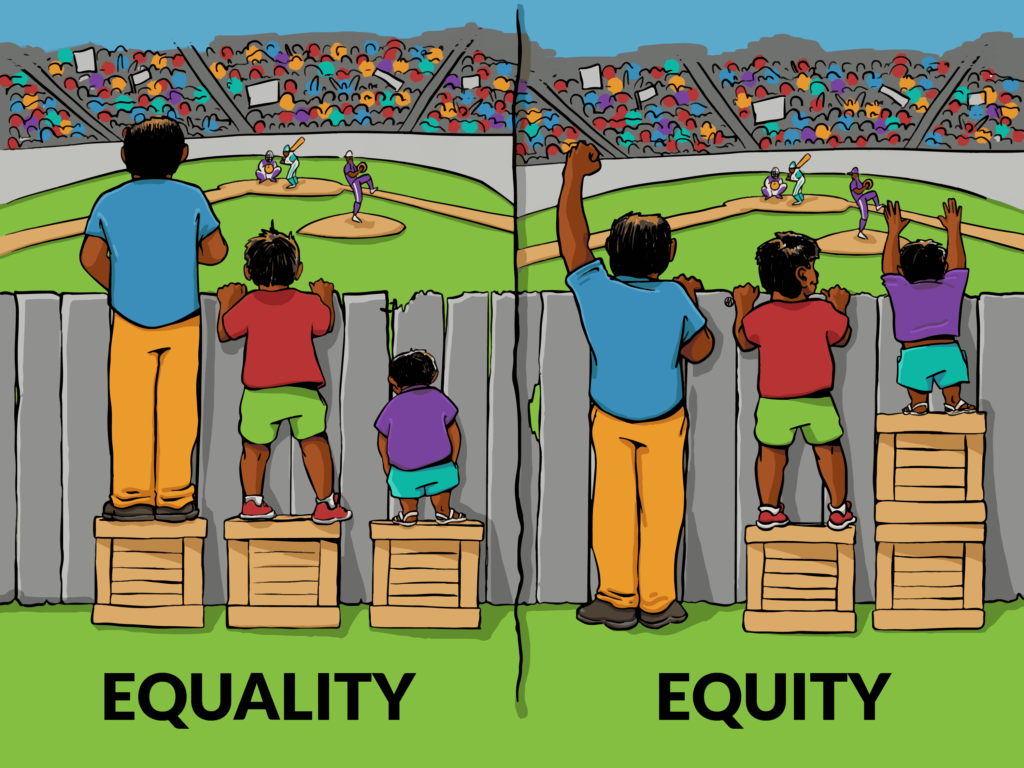
One of my first introductions to what would later become modern social justice training happened years ago while I was working as a Child Protective Services investigator in Arizona. At the time, I was also working toward becoming a therapist, and I believed strongly in treating people equally. I believed investigations should rise or fall on the basis of evidence, not on assumptions about race, culture, or social identity.
That belief created tension almost immediately.
During my CPS work, I attended a newly formed, now-required cultural competence training. To be fair, some of the training had value. Learning about different family structures, communication styles, traditions, and cultural experiences could certainly help professionals avoid arrogance and misunderstanding. I had no problem with learning about people. In fact, I found different cultures fascinating. What troubled me was something else entirely.
I began noticing that many of the conclusions being taught seemed to move away from equality and toward something more subjective, an equity standard.
One example involved discussions surrounding drug use and child neglect. Trainers presented data showing that white women who used powdered cocaine were often less likely to lose custody of their children, while Black women using crack cocaine were far more likely to face child removal. The conclusion presented to us was that systemic racism was the primary explanation.
But I remember sitting there thinking that the analysis felt incomplete. What distinguished powdered cocaine from crack cocaine at that time? Often, money. Powdered cocaine was expensive and generally associated with people who had more resources. Crack was cheaper, more dangerous, and more common in lower-income environments. Families with money often had babysitters, grandparents, attorneys, transportation, stable housing, and social networks that concealed dysfunction or buffered the consequences of poor decisions. Poor families often had none of those things.
In other words, the issue was not simply race. It was resources, opportunity, support systems, education, and environment. Race sometimes correlated with those realities, but correlation and causation are not always the same thing.
Then came the moment that stayed with me. We were given a vignette involving a SNAT case or Suspected Non-Accidental Trauma case involving a boy with a spiral arm fracture, soft tissue bruises, and an African father from a tribal culture that highly valued male children. We were asked whether this cultural background should influence how we interpreted the investigation.
I answered no. I argued that my responsibility was to investigate the evidence objectively and treat every child, parent, and case equally, regardless of the race or culture of the parent involved. I explained that many cultures, including a larger American culture, highly value children. In tragedies, we often especially emphasize the deaths of children as particularly heartbreaking. I did not see how pointing to a cultural preference for male children necessarily changed the evidentiary standards of a child abuse investigation.
The trainers strongly disagreed with me. I was told I needed to consider cultural context differently and that I was failing to understand the purpose of the exercise. I respectfully presented my position to the class. I said I believed justice depended on equality before the standard itself. If we altered standards based primarily on race or culture, then we risked replacing one form of unfairness with another.
The next day, I was told not to return to the training.
At the time, I did not fully realize what I was encountering. Looking back now, I believe I was witnessing an early philosophical shift from equality toward equity. Equality is focused on applying the same standards to everyone. Equity focuses on adjusting standards, expectations, or interpretations in response to historical or social disparities.
I understood the motivation behind it. Many people sincerely wanted to correct real suffering and historical injustice. I respected that impulse then, and I still do now. But I also worried that once we moved away from equal standards and into subjective balancing of outcomes, we entered dangerous territory.
I’ve seen a dangerous unintended consequence over the years, including in parts of Appalachia and Kentucky. Sometimes systems designed to help people survive hardship unintentionally weakened people’s belief in their own agency and ability to overcome adversity. I met individuals and witnessed family members who slowly began to see themselves primarily through the lens of disadvantage, limitation, or dependence rather than through the lens of possibility and resilience.
This was always painful for me to watch because I had been taught the opposite growing up. My people taught me that while life was not always fair, people still possessed dignity, responsibility, and the capacity to fight for a better future. They believed deeply in perseverance and personal determination, even when circumstances were difficult.
Over time, I became concerned that some modern approaches to inequality, while often well-intentioned, risk teaching people that they are primarily products of systems rather than individuals capable of growth, adaptation, and change. In trying to protect people from hardship, we may sometimes unintentionally communicate that they are too powerless to overcome it.
Over time, I watched this philosophy expand far beyond my CPS training. It moved into higher education, counseling, corporate training, public policy, and eventually nearly every major institution in American life. Increasingly, people were encouraged to primarily see one another through categories of race, culture, gender, privilege, oppression, or identity.
Ironically, I felt this often produced the opposite of its intended effect. The more people were taught to emphasize differences, the more divided they became. Instead of seeing one another first as human beings, we increasingly learned to approach one another through suspicion, political identity, or group affiliation. Common humanity slowly gave way to competing narratives of grievance and power.
As a counselor and educator, this troubled me deeply.
Over the years, I worked with clients from many different racial, cultural, and socioeconomic backgrounds, including Native American clients in Arizona, Hispanic families, Black clients, LGBTQ individuals, Appalachian families, deep in the hollar, ministers, addicts, executives, and people whose political beliefs differed dramatically from my own.
What I discovered repeatedly was that counseling relationships rarely grew through emphasizing difference. They grew through connection, trust, humility, empathy, and shared humanity.
A Native American client grieving the loss of his father did not need me to become Native American to understand grief. A Black teenage client struggling with anger did not need me to share his race before he could recognize respect and authenticity. A Hispanic mother overwhelmed by poverty did not need a therapist who mirrored every aspect of her culture. She needed someone who genuinely listened, respected her dignity, and believed in her ability to overcome hardship.
In fact, I often found that if I focused too heavily on our differences, it created distance rather than closeness. Clients would begin to wonder whether I saw them as a fellow human being or merely as a representative of a category.
The strongest therapeutic or educational alliances I experienced came when clients and students realized something important: underneath our external differences, we shared many of the same fears, struggles, hopes, insecurities, and desires.
That does not mean culture is irrelevant. Of course, culture matters. History matters and so does context. Human experiences are shaped by family, community, economics, discrimination, religion, opportunity, and countless other variables. Ignoring those realities entirely would be simplistic. But I also believe there is danger in teaching people that our differences are the deepest or most important thing about us.
Once people stop seeing one another primarily as fellow human beings, polarization becomes almost inevitable. Today, I sometimes worry that we have unintentionally trained ourselves to think tribally. We increasingly sort one another into categories, assume motives based on identity, and approach conversations already divided into teams. In trying to correct inequality, we may have lost sight of equality itself.
My father used to tell me that everyone puts their pants on one leg at a time. The older I get, the more radical that simple statement seems to become.
Dr. Wesley
You’d still get slammed today for thinking this way, but bravo. I’m a journalist, and years (nay, decades) ago it occurred to me that at the core, people from all walks of life care about the same things: good schools, safe communities, decent roads, jobs, a fair shot.
Now, how do we get there? Every community must work that out, and it’s trickier in some than others. But a host of people claiming to be leaders in some communities are actually doing them harm by making race, culture and other issues “the” issue. Are they important to consider? Of course. But they’re outsized and overrated, and steering the conversation from resolutions that truly change a community for the better.