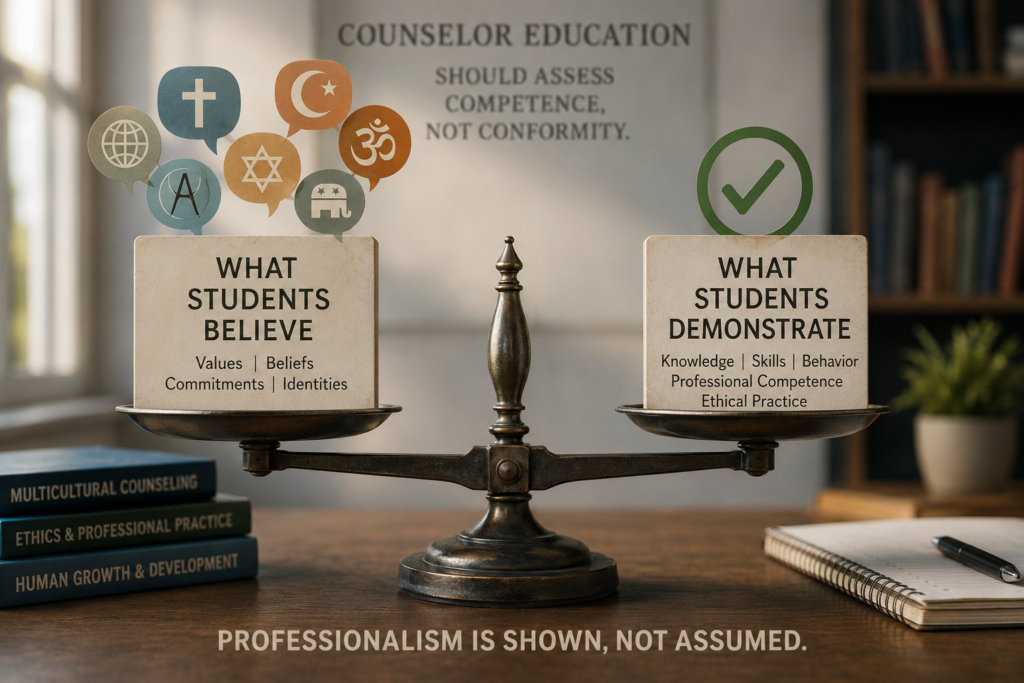
There are some words in our CACREP professional standards that deserve much more attention than they receive. Here are five:
- Commitments
- Characteristics
- Values
- Beliefs
- Behaviors.
Those words appear in CACREP’s 2024 definition of professional dispositions:
The commitments, characteristics, values, beliefs, and behaviors that influence the counselor’s professional growth and interactions with clients, faculty, supervisors, and peers, including working in a diverse, multicultural, and global society with marginalized populations.
At first glance, that may sound harmless. Of course, we want future counselors to develop professionally. Of course, counselors must be able to work effectively with diverse clients. Of course, counselor education programs have a responsibility to identify students whose behavior suggests that they may harm clients.
But read the definition again. CACREP does not simply tell counselor education programs to evaluate students’ knowledge, skills, and professional behavior. It explicitly includes their commitments, characteristics, values, and beliefs.
That distinction matters because CACREP also requires programs to systematically assess each student’s professional dispositions throughout the program. Those assessments occur at multiple points and can be used to inform decisions about retention, remediation, and dismissal. In other words, professional dispositions are not merely suggestions about what makes a good counselor. They are part of a gatekeeping system.
And that raises a question I think counselor education needs to confront: Should we be evaluating what students believe? Knowledge Is Not Belief! Consider CACREP’s standards concerning Social and Cultural Identities and Experiences.
Students are expected to learn theories and models of multicultural counseling, social justice, and advocacy. They must understand how heritage, cultural identities, attitudes, values, beliefs, within-group differences, and acculturative experiences influence people’s worldviews. They must understand how those same factors affect help-seeking and coping.
I have no objection to requiring students to learn these things. Counselor education should expose students to multicultural counseling theories, social justice theory, advocacy models, identity development theories, and competing explanations for human behavior and social conditions. Students should understand the literature well enough to explain it, critique it, apply it appropriately, and work competently with clients whose experiences differ from their own.
Education requires learning ideas. It does not necessarily require believing them. That distinction is foundational to higher education. A student can understand Marx without becoming a Marxist. A student can understand Christianity without becoming a Christian. A student can study feminist theory without becoming a feminist. A student can understand conservative political philosophy without becoming a conservative.
Why should counselor education be different? The purpose of education should be to teach students how to think seriously about ideas, from multiple perspectives, not to determine which ideas they are permitted to believe.
The Problem With Dispositions
Professional behavior certainly matters. Suppose a counseling student refuses to counsel gay clients. Suppose another student repeatedly makes demeaning comments about Christians. Suppose a conservative student attempts to persuade a transgender client to abandon that identity. Suppose a progressive student attempts to persuade an evangelical client to abandon her religious convictions. Those are professionally relevant behaviors.
Evaluate them. If necessary, remediate them. If a student remains unwilling or unable to practice ethically after appropriate remediation, there may eventually be legitimate grounds for dismissal. But notice what we are evaluating. Behavior and professional competence.
We do not need to determine what exists inside the student’s mind. That is why CACREP’s definition troubles me.
- What exactly does it mean to assess a student’s belief?
- How does a professor reliably measure a student’s values?
- What constitutes an acceptable commitment?
- Which personal characteristics are required to become a counselor? And perhaps most importantly:
- Who decides which beliefs, values, commitments, and characteristics receive a passing grade?
Counseling Has Traditionally Warned Against Value Imposition
There is an irony here. One of counseling’s longstanding ethical principles is that counselors should avoid imposing their values upon others.
The ACA Code of Ethics tells counselors to be aware of their values, attitudes, beliefs, and behaviors and to avoid imposing them upon clients. It also specifically extends respect for diversity to trainees and research participants. That principle makes sense.
A counselor possesses enormous relational power. Ethical counseling requires humility about that power. We may disagree profoundly with a client’s religion, politics, relationships, values, or understanding of the world without assuming that our job is to remake the client in our image.
But counselor educators also possess power. We grade students and evaluate them. We approve them for practicum and internship and write recommendations. We determine whether they progress through programs. And, under CACREP’s standards, we participate in processes that can result in remediation or dismissal.
If value imposition is dangerous when counselors possess power over clients, shouldn’t we at least consider whether value imposition can also occur when counselor educators possess power over students?
Multiculturalism Should Include Ideological Diversity
This becomes especially important because CACREP’s definition of professional dispositions specifically connects dispositions to working in a diverse, multicultural, and global society with marginalized populations.
I strongly support preparing counselors to work effectively with people who differ from them. But diversity cannot mean only diversity among the people whose beliefs we approve. A genuinely diverse counseling classroom may contain an evangelical Christian, an atheist, a Muslim, a progressive activist, a political conservative, a libertarian, a traditional Catholic, a secular humanist, a student who embraces contemporary gender theory, and another who has serious philosophical or religious objections to parts of it.
Those students should be expected to treat one another with dignity and respect. They should be expected to understand perspectives other than their own. They should be expected to learn the professional literature. They should be expected to develop multicultural competence and serve clients ethically without imposing their own beliefs onto others. But they should not be required to become ideological copies of their professors. That is not multiculturalism. It is conformity.
There Is an Important Difference Between Belief and Conduct. Perhaps CACREP intends something less troubling than its language suggests.Maybe values, beliefs, commitments, and characteristics are included because they sometimes manifest themselves in professional behavior.If so, CACREP should say that.
A program should be able to evaluate whether a student:
- treats clients and classmates respectfully;
- demonstrates openness to understanding unfamiliar perspectives;
- accurately understands multicultural counseling concepts;
- demonstrates appropriate counseling skills with diverse clients;
- follows ethical standards;
- avoids imposing personal values upon clients;
- responds appropriately to supervision and feedback;
- and demonstrates behavior consistent with competent professional practice.
Those are observable and professionally relevant expectations. But there is an enormous difference between saying “You must demonstrate the ability to counsel clients whose beliefs and identities differ from your own” and saying: “You must hold the correct beliefs about those identities.” The first is professional education. The second approaches ideological screening.
We Should Be Especially Careful When the Measurement Is Subjective
There is another problem. Counseling has spent decades teaching students about good assessment. This was foundational in their first code of ethics from 1961. We tell them that consequential decisions should be based upon reliable and valid information. We teach them about operational definitions, measurement error, inter-rater reliability, construct validity, cultural bias, and appropriate interpretation of assessment results.
Then we sometimes evaluate something as amorphous as a student’s values or beliefs using a faculty-created rubric. The counseling literature itself has wrestled with this problem. Researchers have noted the lack of professional consensus about precisely what counselor dispositions are, while others have developed instruments in an effort to establish greater reliability and validity.
That should make us cautious. If a measure can contribute to remediation or dismissal from a graduate professional program, the burden for clarity, reliability, fairness, and due process should be exceptionally high. A student should never have to wonder… Am I being evaluated because I behaved unprofessionally, or because my professor dislikes what I believe?
CACREP could solve much of this problem with a relatively simple change. Professional dispositions could be defined primarily through observable professional behaviors and demonstrated competencies, rather than attempting to evaluate private commitments, values, beliefs, or personal characteristics. Programs should intervene when there is evidence of professionally problematic behavior, not because faculty believe they can predict how a student’s private beliefs might someday influence professional conduct.
Counselor educators cannot reliably predict future behavior by drawing ideological inferences from a student’s beliefs. A student may believe that homosexuality is sinful. Another may believe that traditional Christian sexual ethics are harmful. Another may believe that a particular political movement threatens democracy, while a classmate believes that the opposing movement does. Faculty members may have strong opinions about what those beliefs imply about a person’s character, tolerance, safety, or fitness to counsel. But those implications are interpretations, not behaviors.
And interpretations are especially vulnerable to ideological bias. We can construct chains of reasoning that make almost any contested belief appear professionally suspect: If you believe X, then you must also believe Y; if you believe Y, you will probably treat people who believe Z in a particular way. That is not sound assessment. It is speculation, and the conclusions will too often reflect the political, moral, and theoretical assumptions of the person doing the evaluating.
Counseling should know better, as our own scholarship is not immune to poorly examined assumptions, including those embedded in theories of identity, power, oppression, privilege, religion, politics, and culture. The fact that an interpretation appears in counseling scholarship does not make it ideologically neutral, nor does professional consensus transform a contested social or political proposition into an observable characteristic of an individual student.
So, the professional question should not be… What does this student’s belief tell us about the kind of counselor we think this person might become?The question should be… What has this student actually demonstrated? Can the student understand a client’s worldview, respect client autonomy, avoid imposing personal values, respond appropriately to supervision, and provide competent and ethical counseling? Those things can be demonstrated through coursework, role plays, supervision, practicum, internship, and actual interactions with others.
If a student behaves in ways that are discriminatory, coercive, demeaning, unethical, or clinically incompetent, address the behavior. Document it. Evaluate it according to clearly articulated professional standards. Remediate it when appropriate. But do not turn a student’s religious, political, moral, or philosophical beliefs into evidence of misconduct that has not occurred. Evaluate what students do, not what faculty fear their beliefs might cause them to do.
Counselor Education Needs Viewpoint Diversity
There is a broader issue here that goes beyond one CACREP definition. Counselor education should make an explicit commitment to viewpoint and ideological diversity. Students should know that disagreement with faculty members, professional organizations, political movements, social theories, or prevailing academic orthodoxies will not, by itself, jeopardize their standing in a counseling program.
That protection should extend in every direction. Conservative students should be able to question progressive ideas. Progressive students should be able to question conservative ideas. Religious students should be able to challenge secular assumptions and secular students should be able to challenge religious assumptions. Students should be able to question social justice theories, traditional moral systems, DEI frameworks, capitalism, socialism, gender theory, religious doctrine, political movements, and even the assumptions of the counseling profession itself. Their responsibility is not to agree. Their responsibility is to think, learn, behave professionally, and counsel ethically. Faculty should be held to the same standard.
What I Would Change
I would like to see CACREP reconsider its definition of professional dispositions and explicitly distinguish personal worldview from professional conduct. I would also like counselor education programs to adopt several safeguards.
Dispositional evaluations should be tied as closely as possible to observable, professionally relevant behaviors. Criteria should be clearly defined before students are evaluated. Significant gatekeeping decisions should use multiple evaluators and multiple sources of evidence. Students should have meaningful opportunities to respond to assessments and appeal consequential decisions. Remediation should identify specific professional competencies or behaviors that require improvement rather than demand ideological agreement.
And perhaps most importantly, programs should explicitly affirm that students will not be remediated or dismissed merely because they hold religious, political, moral, or philosophical beliefs that differ from those of faculty members or from dominant perspectives within the counseling profession.
That would not weaken multicultural counseling. I think it would strengthen it. Because the ultimate test of multiculturalism is not whether we can welcome people who look different from us while believing substantially the same things. The harder test is whether we can make room for people who genuinely see the world differently. Counseling asks our clients to trust us with that difference. Counselor education should be willing to do the same with its students.
Dr. Wesley