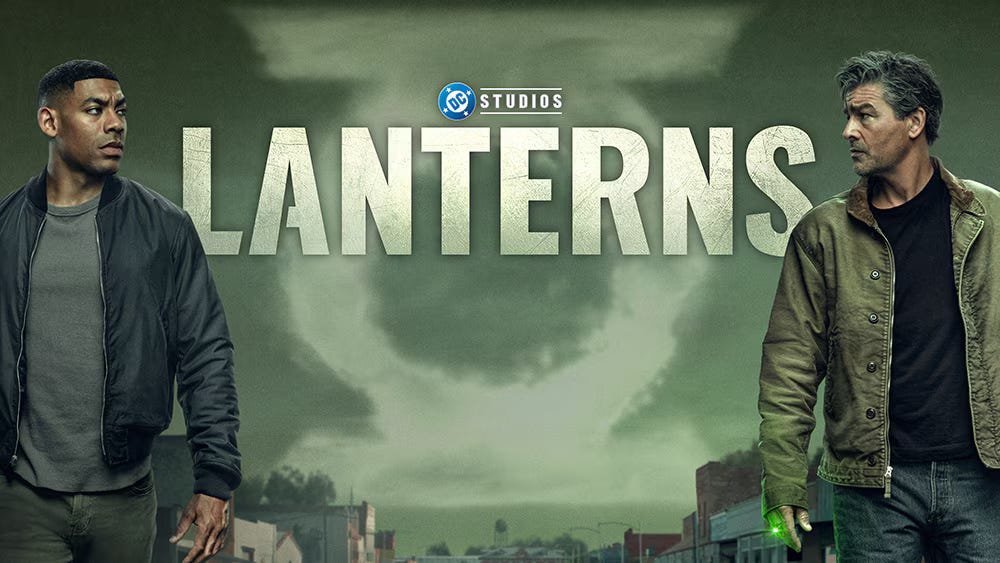
I have been watching the new HBO series Lanterns, and there is a lot about the show that I find interesting. I grew up with superheroes, and like a lot of adults who grew up reading comics, I still enjoy seeing these old characters reimagined for another generation. But there was one storyline in Lanterns that bothered me enough that I found myself thinking about it long after the episode ended. Maybe that is partly because I am a counselor and have spent much of my adult life thinking about how people learn, how children develop, and how experiences shape us. Maybe it is also because I spent part of my younger life helping raise a house full of children who were not my own. Whatever the reason, I couldn’t watch this particular scene simply as entertainment.
For those who don’t know the Green Lantern story, the Lanterns are chosen to protect the universe, and one of the qualities required of them is the ability to overcome fear. In this new series, we learn that John Stewart’s parents believed when he was still a child that their son might someday be chosen to become a Green Lantern. They wanted to prepare him for that possibility, which meant teaching him to become fearless. At first, there is something almost admirable about that idea. Most parents want their children to become brave, confident, and capable of facing difficult things. But the way John’s parents teach fearlessness takes a disturbing turn. As a young boy, John puts an apple on his head and his father shoots it off with a firearm. Later, the test is reversed, and John is expected to shoot an apple from his parents’ heads. The gun becomes part of a family ritual for proving courage. Surviving the danger becomes evidence that John is becoming the person he is supposed to be.
I understand what the writers are trying to accomplish, and this isn’t necessarily being presented as good parenting. They are giving us the backstory of John Stewart and showing us the extraordinary, and probably traumatic, childhood experiences that shaped the man he became. I understand all of that intellectually. Still, as I watched it, I kept thinking about children and adolescents who will see the scene. Yes, Lanterns is an adult television program. Parents should pay attention to ratings and decide what their children watch. But let’s also be realistic. Green Lantern is a comic-book superhero. These characters have been marketed to children for generations. Children know them. Teenagers know them. Action figures, costumes, cartoons, comics, video games, and superhero movies have made them part of childhood culture. It seems naive to imagine that younger viewers will not find their way to this series.
What concerns me isn’t simply that children might see violence. Children have been watching superheroes fight villains for generations. What bothers me is the particular lesson embedded in this scene. Courage becomes associated with unwarranted danger. If you want to prove you aren’t afraid, put yourself at risk of death. If you really trust another person, allow that person to point a loaded gun at you. If you want to demonstrate that you are fearless, point a gun at someone you love. Then, when everyone survives, celebrate the accomplishment. I realize that isn’t the lesson the writers necessarily intended, but children don’t always interpret stories through the sophisticated psychological framework of the adults who wrote them. Sometimes they simply see something that looks exciting and wonder whether they can do it too.
I learned something about that many years ago when Dawn and I worked as houseparents. We were raising our own children while also helping raise other children, which meant our house could be a pretty lively place, especially in the mornings when everyone was getting ready for school. One of the things I began noticing was how differently those mornings went depending on what the kids watched before the school bus arrived. If they had been watching something relatively calm, things usually remained fairly calm. But if they had been watching Power Rangers, there was a good chance that within a few minutes, somebody in our house was going to become a Power Ranger. Suddenly there were kicks, punches, karate moves, and children chasing one another around the house. Sometimes that energy followed them right onto the school bus, and the bus driver ended up dealing with the consequences.
I wasn’t conducting research. I wasn’t keeping spreadsheets or randomly assigning children to television conditions. I was just a young houseparent trying to get a bunch of kids dressed, fed, and onto a school bus without anyone losing a shoe or getting kicked in the head. But I saw something repeatedly that psychologists have studied much more carefully for decades. Children imitate. They watch people, particularly people they admire or find exciting, and they try behaviors themselves. That doesn’t mean watching a violent television program automatically creates a violent child. Human development is far more complicated than that, and the research on media violence deserves more nuance than it sometimes receives. But we don’t have to believe that television turns children into violent people to recognize something much simpler: children sometimes reenact what they see.
Most of the time, that imitation is harmless or at least relatively harmless. A child ties a towel around his neck and becomes Superman. Someone grabs a cardboard tube and suddenly has a lightsaber. A kid watches professional wrestling and tries a move on his brother that seemed like a much better idea on television. My little Power Rangers occasionally kicked each other harder than they intended. Childhood has always involved pretending, and some of that pretending includes risk. The difference with a gun is that there is almost no margin for error. A child who misjudges a karate kick might cause a bruise. A child who misjudges whether a gun is loaded can end a life.
We don’t have to search very far to find examples. In January 2025, a six-year-old Kentucky boy reportedly found a loaded handgun that had been kept under a pillow in the room where he slept. He accidentally shot himself in the head. Stories like that are heartbreaking, but they are not isolated. Children find firearms. Teenagers show guns to friends. Someone thinks the gun isn’t loaded. Someone wants to make a video. Someone points it as a joke. Someone wants to prove he isn’t afraid. Someone pulls the trigger. There is no director to yell cut, no special-effects department, and no opportunity to shoot the scene again.
That is why the apple scene bothers me more than much of the fantastic violence in superhero stories. Superman can fly, but children can’t. Green Lantern can create objects with a magical ring, but children don’t have magical rings. Kids understand that much of what superheroes do belongs to a world of fantasy. But children and teenagers do sometimes have access to firearms, and shooting an object from another person’s head is an action they can understand, imagine, and attempt. When that behavior is connected to bravery, trust, approval, and ultimately becoming a superhero, I think we should at least stop and ask whether we have crossed a line from fantastic violence into something much easier to imitate.
There is another part of this that interests me as a counselor. I am not sure fearlessness is something we should be teaching children to aspire to in the first place. Fear gets a bad reputation. We talk about conquering fear, overcoming fear, defeating fear, and refusing to be controlled by fear. Certainly, there are times when fear limits us unnecessarily. People avoid relationships because they are afraid of being hurt. They stay in jobs they hate because they fear change. They don’t pursue opportunities because they are afraid of failing. Learning to move forward despite those fears can be an important part of becoming a healthy adult.
But fear also has a job to do. Fear is one of the reasons our ancestors survived long enough for us to be here. Healthy fear tells us not to step too close to the edge of a cliff. It tells us to slow down when the road is covered with ice. It tells us to pay attention when something doesn’t feel right. It tells a child not to touch a hot stove. And yes, healthy fear should tell us that putting an apple on someone’s head and firing a bullet toward it is an extraordinarily bad idea. The goal of emotional maturity isn’t to eliminate fear. It is to learn the difference between fear that unnecessarily restricts our lives and fear that is giving us information we would be foolish to ignore.
Maybe that is where Lanterns unintentionally gets courage backward. Courage isn’t proving that you aren’t afraid of anything. Courage is being able to experience fear, understand the danger, and still act when something important requires action. Sometimes courage means running toward danger because another person needs you. Sometimes courage means standing up to someone more powerful than you. Sometimes it means telling the truth when lying would be easier, admitting you were wrong, walking away from people who are cheering you toward something dangerous, or saying no when everyone around you is calling you a coward.
And sometimes the courageous thing is deciding not to pull the trigger.
I don’t want television writers to remove violence from television, and I certainly don’t believe every program needs to be sanitized because a child somewhere might watch it. Parents have responsibilities, too. Lanterns was not created as children’s programming, and I understand that. But writers also make choices, particularly when they are working with characters who have been part of children’s popular culture for generations. The writers could have created dozens of ways for young John Stewart to confront fear. Heights. Darkness. Isolation. Failure. Physical endurance. Standing up to someone stronger than himself. Protecting someone else despite being afraid. Any of those could have explored what it means to develop courage. Instead, they chose a gun and put an apple on a child’s head.
Maybe most young people who see that scene will never give it another thought. I hope that is the case. But I have raised enough children, worked with enough families, and spent enough years as a counselor to know that adults are sometimes surprised by what children decide to imitate. They don’t always understand probabilities, consequences, permanence, or how quickly play can become tragedy. Sometimes they simply see something exciting and want to know whether they can do it too.
There are many things I would be happy for children to learn from superheroes. Stand up for someone who is weaker than you. Help people who are in trouble. Tell the truth when lying would be easier. Protect others. Face adversity. Get back up when life knocks you down. Do what is right even when doing it scares you.
Those are lessons about courage worth teaching. Putting an apple on someone’s head and pulling a trigger isn’t fearlessness. It is exactly the kind of thing healthy fear should stop us from doing.
Dr. Wesley