When I was younger, I remember learning about the Great Depression. I read about the poverty of the 1930s, saw photographs of breadlines and families who had lost nearly everything, and watched The Grapes of Wrath. It all seemed like some distant, terrible period of American history, except that it really wasn’t that distant for me. My grandparents had lived through it. So, one day I asked my grandfather what it had been like to live during the Great Depression. He laughed and told me that he didn’t know there was a Great Depression. That answer has stayed with me for years.
It wasn’t that his family had somehow escaped poverty. Quite the opposite. They had very little. But, as he explained it, so did everyone else around them. He didn’t have noticeably more or less than the families he knew. There wasn’t much to compare his life to, so he didn’t spend much time thinking about what he was missing. By almost any modern standard, my grandparents were very poor. I’m just not sure they always knew they were poor, at least not in the way we think about poverty today.
Their lives were certainly hard. Children worked because families needed them to work. Education was important, but survival came first. My father was the only high school graduate in his family who came before him. My grandparents didn’t have that opportunity, and neither did my mother. Their families were large, money was scarce, and children weren’t simply dependents who spent their days in school, played ball in the afternoon, and came home asking what was for dinner. They were part of the economic machinery that kept a family alive. I don’t romanticize that. My mother deserved the opportunity to finish school. My grandparents deserved indoor plumbing, better healthcare, financial security, and some relief from the backbreaking work that occupied so much of their lives.
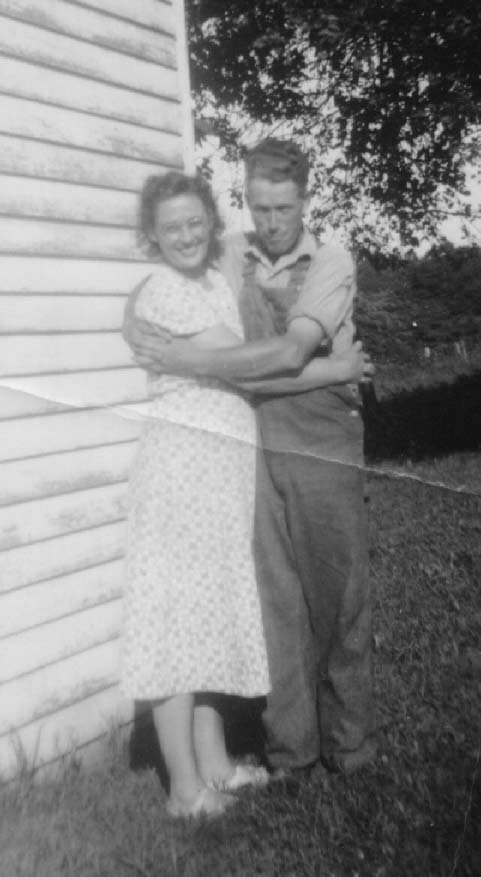
Still, when my grandfather talked about those years, he didn’t talk about them as years of misery. He talked about them as hard years, certainly, but also as happy years. See the pic of them getting a hug beside their home. People worked, but they worked together. Neighbors helped one another. Families went to church. People visited. They sat on the porch and talked. They fished. Even fishing was different. Nobody caught a perfectly good bass, took a picture of it, and threw supper back into the lake. Fishing was recreation with a purpose. You sat beside the water, talked, laughed, rested for a while, and hopefully brought home something the family could eat. Much of life was like that. Work, family, community and survival were intertwined. Shoot, I remember going out with my grandpa doing some frog gigging for lunch the next morning. I loved watching those frog legs jumping in the frying pan.
What they didn’t have was a constant reminder of everything they lacked. There was no television in every room showing them houses they couldn’t afford. There was no HGTV informing them that the cabinets in their kitchen were embarrassingly outdated. There was no Facebook announcing that someone else’s children were more successful than theirs, no Instagram showing them someone else’s European vacation, and no TikTok algorithm delivering an endless parade of younger, richer, thinner, happier and better-dressed people directly into their hands. They didn’t have influencers explaining which ten things they absolutely had to own before Christmas.
They did have the Sears and Roebuck catalog. For families like theirs, those pages offered a glimpse into a world of store-bought clothes, furniture, tools, toys, and plenty of things they might never own. I imagine there was some pleasure in looking through it, perhaps even a little dreaming about what it would be like to have some of those things. But eventually the Sears and Roebuck catalog found its way to the outhouse, where it served a much more practical purpose. After you had looked at all the things you couldn’t afford, you could tear out a page and wipe your ass with it. There may be a life lesson in there somewhere.
I wonder if my grandparents understood something we have forgotten. Today, we live with luxuries they could scarcely have imagined. We push a button on the wall and make the house warmer or cooler. We have televisions in several rooms whose only purpose is to entertain us. We have refrigerators and freezers full of food. We carry devices in our pockets that give us immediate access to nearly every book, song, movie, newspaper, map, and piece of information in the world. Most of our children aren’t expected to spend several hours every day working to help feed the family. Instead, they are expected to go to school, not just elementary school, but high school, college, and increasingly graduate school. Things that would have seemed like extraordinary privileges to my grandparents have become so ordinary that we barely notice them.
At the same time, we have constructed a remarkable machine for reminding ourselves, every hour of every day, that somebody else has more. My grandfather mostly compared his life to the people around him, and they lived the same way he did. We compare ourselves with the entire world. Actually, it may be worse than that. We don’t compare ourselves with the entire world because that would include billions of people who have considerably less than we do. We compare ourselves with a carefully selected slice of the world consisting disproportionately of people who appear to have more.
We compare our messy kitchen with somebody else’s remodeled one, our aging body with somebody else’s best photograph, our used truck with somebody else’s new one, and our difficult Tuesday afternoon with somebody else’s week in Tuscany. We know all the disappointments, worries, arguments, and mundane moments in our own marriages, then compare them with somebody else’s anniversary post about being married to their best friend. We know our children’s struggles and mistakes while seeing photographs of everyone else’s children receiving awards, graduating from college, and announcing promotions. We are comparing the unedited version of our own lives with the highlight reel of everybody else’s.
Perhaps that helps explain one of the strange contradictions of modern life. By many material measures, we have more comfort, opportunity, entertainment, education, and convenience than previous generations could have imagined, yet it doesn’t always feel like enough. I don’t think the answer is to tell younger generations to quit complaining because Grandpa had to walk five miles uphill through the snow to get to school. People today have legitimate struggles. Housing is expensive. Healthcare can be frighteningly costly. Young adults face economic pressures that are different from those their grandparents faced. Loneliness is real. Families struggle. People suffer. Poverty wasn’t wonderful just because my grandfather could remember some happy times during it.
But prosperity doesn’t automatically produce contentment either. We tend to assume that if people have more, they should naturally feel that they have enough. Human beings don’t seem to work that way. Enough is rarely determined simply by what we possess. It is also influenced by what we see other people possessing.
My grandfather didn’t know he was supposed to feel deprived. The people around him were living much the same way he was. What mattered wasn’t whether somebody a thousand miles away had a better house. He didn’t know what somebody a thousand miles away had. What mattered was whether the garden produced, whether there was enough food for supper, whether somebody needed help, whether the fish were biting, and whether there would be people to talk with after church on Sunday. His world was smaller than ours, but perhaps that smaller world occasionally made it easier to recognize when he had enough.
Sometimes I wonder what would happen if we measured our lives that way again. Instead of constantly asking what someone else has that I don’t, perhaps we could occasionally ask whether I have enough. None of this requires us to give up air conditioning, education, indoor plumbing, smartphones, or Netflix. I’m certainly not volunteering for that. Progress is a good thing. I am glad my children and grandchildren have opportunities my grandparents never had, and I hope the generations that follow them have opportunities we cannot yet imagine. But perhaps progress should make our lives better without convincing us that better will never be enough.
My grandfather lived through the Great Depression and didn’t know there was one. We live in an age of extraordinary abundance and sometimes have to be reminded that we have quite a lot. The difference isn’t entirely in what we have. Some of it may be in what we have learned to compare it to. And maybe every once in a while, when the Sears and Roebuck catalog of everything we don’t have becomes too much, we should remember what my grandparents did with theirs.
Dr. Wesley