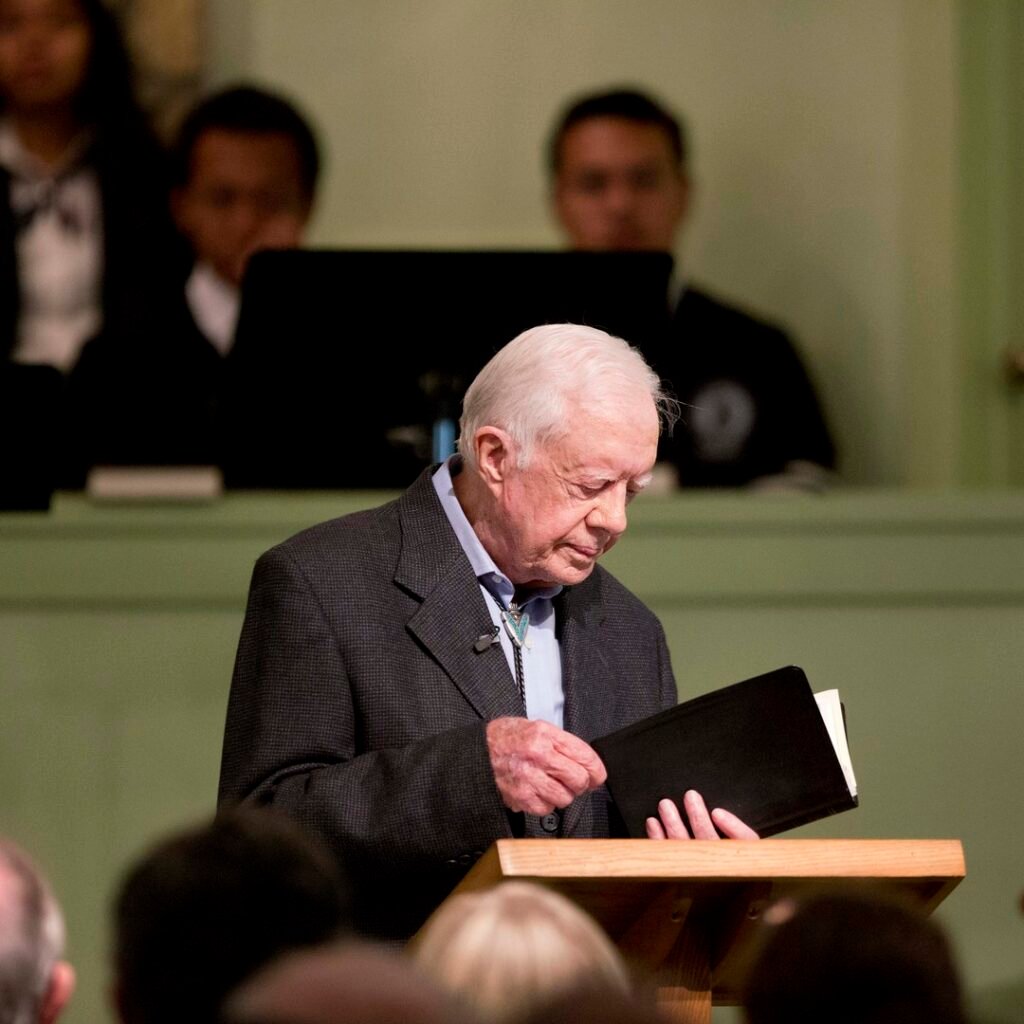
I was almost thirteen years old in the summer of 1976 when my father took me to a large religious rally in Phoenix, Arizona. It was America’s Bicentennial, and everything seemed wrapped in red, white, and blue. Patriotism and faith were woven together so tightly in those days that it was hard to tell where one ended and the other began. I remember the crowd being large, the room feeling electric, and Hal Lindsey coming to the podium. My father loved Hal Lindsey and his prophetic interpretations of world events. In those years, The Late Great Planet Earth was nearly required reading in many evangelical homes.
What I remember most was not the setting, but a line that stuck with me. “Gerald Ford says he is a Christian. I believe Ronald Reagan is a Christian. But I know Jimmy Carter is a Christian.” The crowd erupted.
Jimmy Carter was not simply a politician who happened to attend church. He openly talked about being born again. He taught Sunday school. He spoke the language of faith in a way that felt familiar to evangelicals. For many Christians weary from Watergate, Nixon, and national cynicism, Carter represented something different, something cleaner. He seemed decent, honest, and grounded. He felt like one of us. And that mattered because in those days, at least for many evangelicals, character still seemed to matter more than image.
But things changed. Carter’s Playboy interview later that year rattled many Christians. His now-famous admission that he had “lusted in his heart” was an honest confession, rooted in the very words of Jesus from the Sermon on the Mount. Yet honesty is often costly. Many believers did not know what to do with a man who spoke so plainly about his inner life. Here was a man openly confessing his flaws, acknowledging that the moral struggle was not merely “out there” in the world, but inside himself. That is exactly the kind of inward work Jesus called people toward. But the movement itself was beginning to look outward. Then came the Iran hostage crisis, gas shortages, inflation, and a national sense of weakness. Fairly or unfairly, Carter became the face of American humiliation.
And then came Ronald Reagan. Reagan was different. He carried himself like the cowboy, the strongman, the man who could restore order. He projected certainty. Resolve. Strength. He looked like the kind of man who would win the gunfight at high noon. For many evangelicals, this image became compelling. The Moral Majority found in Reagan a political home, particularly around abortion, even though Reagan’s own history on abortion was far more complicated than many remember.
Something shifted. It seems to me that somewhere between Carter and Reagan, many American Christians began exchanging the ethic of Jesus for the aesthetics of power. The Jesus of the Beatitudes, blessed are the meek, blessed are the peacemakers, blessed are the merciful, slowly gave way to something harder, more masculine, more militant. I remember religious art changing too. The soft shepherd images gave way to warrior Jesus, muscular angels, battle-ready saints. Somewhere in those years, the language of faith began to change as well.
This was also the rise of spiritual warfare language, at least in the circles I grew up in. Suddenly Satan was behind everything. Christians were binding demons, rebuking principalities, and looking for dark spiritual forces under every rock. Every cultural disagreement became a battle. Every social change became an attack by dark forces. Every political loss became evidence of spiritual decline. It was as if the faith itself had become a battlefield.
And with that shift, the Sermon on the Mount seemed to fade into the background. Love your enemies became fight your enemies. “Judge not”, became “call it out”. “Blessed are the peacemakers” became “stand your ground”. Mercy often gave way to certainty, humility to militancy, and the difficult inner work of confession was replaced by the easier task of identifying evil in someone else.
That may be one of the deepest ironies of all. Jimmy Carter’s confession in 1976 was deeply biblical. He was doing the hard work of examining his own heart. But many Christians were already beginning to move toward a faith more focused on hunting enemies than confronting themselves.
Even phrases like love the sinner, hate the sin became rallying cries, often aimed at social issues that Jesus himself never directly addressed. New moral battlegrounds emerged, many shaped as much by politics and social anxiety as by theology.
And now, fifty years later, as we approach America’s 250th anniversary, I find myself reflecting on that journey. I think back to that rally in Phoenix, when evangelicals cheered for a humble Baptist Sunday school teacher because they believed faith and character mattered. It feels almost unrecognizable now.
Today, we live in an era where our president posts images of himself transformed into superheroes, warriors, boxers, and fighters… even God, through carefully crafted memes. Strength is marketed. Power is worshiped. Absurdity is normalized. And many believers celebrate these symbols without asking whether the image resembles the carpenter from Nazareth.
Maybe every age makes God in its own image. Maybe that has always been the danger. Maybe that is the great question for America at 250. Not simply what kind of nation we have become, but what kind of God we have chosen to reflect. Because in the end, the God we imagine often tells us more about ourselves than about God.
Dr. Wesley