Last week, Dawn and I celebrated our 41st wedding anniversary. Forty-one years. It hardly seems possible. Like most couples, we’ve experienced seasons of abundance and seasons of scarcity, moments of certainty and moments when we wondered how everything would work out. We’ve made wise decisions and foolish ones. We’ve had victories worth celebrating and mistakes we’d gladly do over if life offered rewinds. Yet as I look back over those four decades together, one decision stands out as one of the wisest we ever made. It wasn’t where we lived, what careers we pursued, or even where we chose to worship. It was the simple decision that we would not begin our marriage under a mountain of debt.
As a counselor, I’ve sat with countless couples over the years as they struggled to keep their marriages together. Every relationship is unique, but some themes repeat themselves with remarkable consistency. Financial stress has a way of magnifying every other problem. A disagreement over money is rarely just about money. It becomes about fear, security, priorities, trust, and sometimes even identity. Of course, no couple can avoid financial hardship entirely. Jobs disappear. Medical bills arrive unexpectedly. Economies change. Those things happen. What has always saddened me, though, is watching couples begin their marriage already carrying burdens they voluntarily placed upon themselves in pursuit of one perfect day.
Today’s wedding industry has become enormous. The average American wedding now costs well over $30,000, and many cost considerably more than that. Some celebrations rival the price of a new automobile or even a down payment on a home. None of that makes a marriage stronger. It simply makes the first years together financially heavier. Somewhere along the way, we’ve confused celebrating a marriage with producing a performance.
Our wedding was beautiful. Not because it was expensive. Because it was ours.
I still remember standing there in my tuxedo, knowing I was about to marry the woman I loved. The funny part is that the tuxedo wasn’t rented from some high-end formal wear shop. I had found it at the Salvation Army for seven dollars. Seven dollars. In fact, while I was there, I found tuxedos for my brother, who served as my best man, along with the groomsmen, the ring bearer, and others. Five dollars each. They weren’t the newest style, and they certainly weren’t designer labels, but they fit, they looked respectable, and they allowed us to spend our money on things that actually mattered.
Looking back now, I can’t remember anyone commenting on those tuxedos. I doubt anyone remembers whether the lapels were fashionable or outdated. What people remember is that two young people stood before their family and friends and promised to spend their lives together.
Dawn’s wedding dress may be my favorite part of the story. She found it at a J.C. Penney Outlet for thirty dollars. Then she made it her own. She sewed pearls into it and added the little touches that transformed an inexpensive dress into something beautiful and uniquely hers. It wasn’t purchased because it carried a prestigious designer’s name. It became special because she invested herself into it. Somehow, that seems like an appropriate metaphor for marriage itself. The things we personally invest ourselves in almost always become more valuable than the things we simply purchase.
Our ceremony itself reflected the same philosophy. The ministers didn’t cost us a thing because they happened to be our fathers. My dad and Dawn’s dad shared one of the greatest privileges a father can experience by helping unite their children in marriage. The church did charge us fifty dollars, however, which our family jokingly considered something of a scandal since my father had once pastored there. We borrowed an arch and some ceremonial candles instead of renting elaborate decorations. My mother baked the wedding cake herself. Family members pitched in. Friends helped. There wasn’t a wedding planner coordinating every minute of the day. There were simply people who loved us enough to contribute what they could.
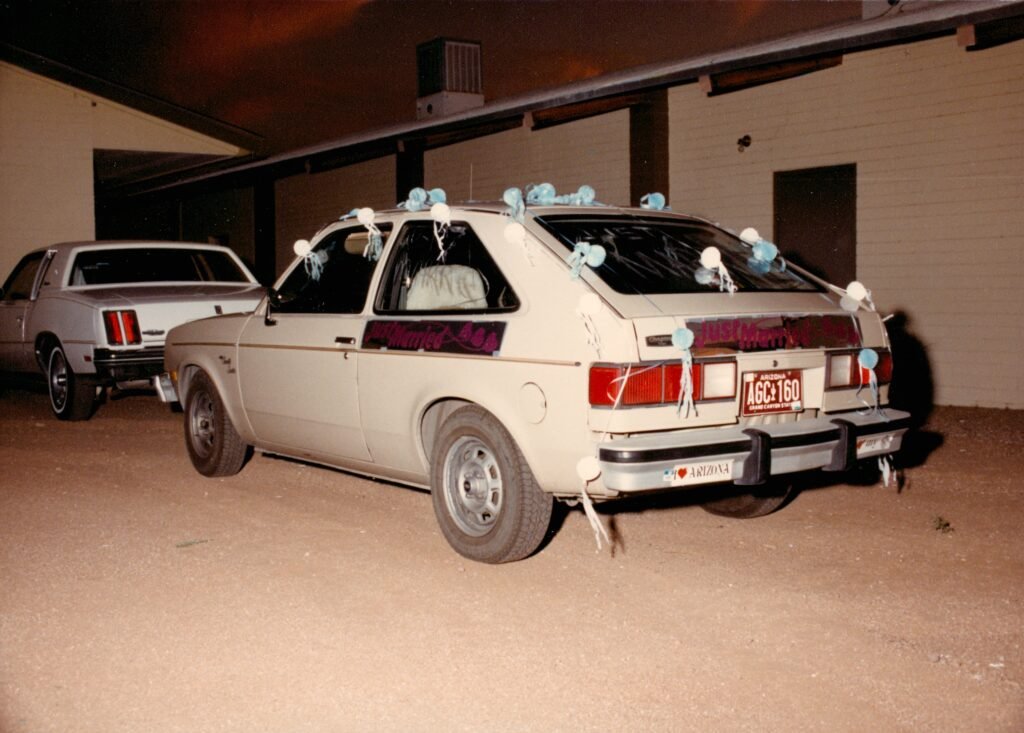
Then came the grand departure. Like every young groom, I suppose I imagined driving away in a Corvette someday. Instead… We drove away in a used Vette. A Chevette. Even after all these years, that still makes me smile.
I suspect I’ll never own the Corvette I dreamed about as a young man, but that little Chevette faithfully carried two newlyweds toward the beginning of a life together. Looking back, I wouldn’t trade that memory for anything.
Our honeymoon wasn’t on a tropical beach or at some luxury resort. We spent it at Kohl’s Ranch near Payson, Arizona, only about an hour and a half from where we would soon begin our married life. We enjoyed the quiet, explored the beauty of the mountains, and one evening drove into Payson to watch the brand-new movie, Rambo. To someone else, that may sound wonderfully ordinary. To us, it was perfect. We didn’t need luxury to enjoy one another’s company. Nature, conversation, and the excitement of beginning life together were more than enough.
Something else strikes me now that I couldn’t have appreciated at twenty-two years old. We invested sweat equity into our wedding. We didn’t simply write checks and let someone else create our memories. We searched secondhand stores. We borrowed what we needed. We baked, sewed, carried, assembled, and cleaned. Family members gave not just money but their time, creativity, and effort. In hindsight, I wonder if all of that unknowingly prepared us for marriage itself. A good marriage cannot be outsourced. No one else can build it for you. It requires your own sweat equity every single year.
Please don’t misunderstand me. I’m not suggesting there is anything morally wrong with an expensive wedding if a couple can genuinely afford it. Every family celebrates differently, and every couple should create memories that reflect who they are. My concern is different. When a celebration becomes more important than the marriage it celebrates, something has quietly drifted out of balance. The wedding lasts a day. The marriage, if we’re fortunate, lasts a lifetime.
Dawn and I certainly haven’t done everything right. We’ve made financial mistakes over the years, just like everyone else. We’ve faced unexpected expenses, difficult decisions, and seasons when money was tighter than we would have liked. But we never had to spend our first years together paying for a wedding we could barely remember. Instead, we began with a clean slate, modest expectations, and a determination to build our life one day at a time.
Forty-one years later, I couldn’t tell you who noticed my seven-dollar tuxedo. I don’t know if anyone remembers that the decorations were borrowed or that the cake was homemade. I doubt many people remember that our honeymoon was only a short drive from home.
But I remember the smile on Dawn’s face. I remember saying, “I do.”
I remember climbing into that little Chevette and beginning an adventure neither of us could have imagined. I remember driving through a McDonald’s, with our “Just married” stickers attached, and everyone yelling their blessings.
The older I become, the more convinced I am that lasting marriages are rarely built on extravagant beginnings. They’re built on ordinary days. They grow through shared hardships, quiet faithfulness, forgiveness freely given, laughter when life doesn’t go according to plan, and thousands of small decisions to keep choosing one another.
Sometimes I think that little Chevette was a better wedding car than a Corvette ever could have been. It reminded us from the very first mile, that happiness doesn’t come from what carries you away from the wedding. It comes from who is sitting beside you for the journey.
Dr. Wesley