It came to me somewhere between waking and sleep. Not the kind of dream that feels strange or distant, but one of those that feels almost remembered, like it had already happened and I had just forgotten it for a while. I was lying there, not quite asleep, not fully awake, and the images started to come together as if someone were telling me a story I already knew.
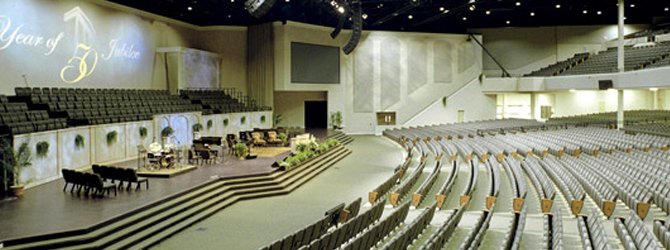
I found myself back in the early 1980s, but everything felt just a little different. I was standing in the back of Thomas Road Baptist Church in Lynchburg, Virginia. I knew this church well because I graduated from Liberty University. The room was filled with pastors, men whose names I recognized, voices that would later become loud in shaping the direction of the American church. At the front was Jerry Falwell, but he wasn’t speaking yet. He was listening.
An older pastor stood up in the back. His voice was steady, but there was weight behind it. He didn’t talk about politics or influence. He talked about the past, about segregation, about silence, about moments when the church had chosen comfort over courage. He said plainly that they had not loved their neighbors the way Jesus commanded.
No one rushed to respond. No one corrected him. And then something unexpected happened. One by one, others began to speak. Not to defend themselves, but to confess. The room didn’t feel strategic. It felt honest. Almost unguarded.
In my dream, Falwell eventually stepped forward, but not as history, and I think I remember. He didn’t rally them toward political power. He called them toward repentance. …and everything changed.
My dream shifted, and now I was sitting in a small church a few years later. The kind of place I grew up in, wooden pews, a piano slightly out of tune, the smell of coffee lingering in the air. The pastor stood up and said something simple: “Before we try to change the world, we need to ask forgiveness for how we’ve failed to love it.” People nodded. Some quietly wiped tears. There was no applause. Just a sense that something real and things were going to change.
And from there, the story kept unfolding.
When the AIDS crisis came, I watched as churches responded, not with fear, but with movement toward people. I saw a hand-painted sign outside a church, nothing polished, just steady letters: Jesus loves Gays. So do we.
Inside, volunteers sat beside hospital beds. They didn’t have answers for everything. They didn’t resolve every theological question. But they showed up… again, and again. And somehow, that seemed to matter more than anything they could have said.
The dream moved again.
I found myself in a fellowship hall somewhere in eastern Kentucky in the 1990s. Folding chairs, weak coffee, and a few people sitting in a circle. Some looked worn down in a way you can’t fake. Meth. Pills. Lives that had been pulled apart slowly. There was no program. No script. Just a pastor who said, “You can come here as many times as it takes because Jesus loves you and so do we.” Some people didn’t make it. Some did. But no one was turned away.
Then my dream shifted to a long table outside a small church near the border in Texas, which had been sponsored by Joel Osteen Ministries. In my dream, Joel was not a prosperity gospel preacher but had used his gifts to serve those less fortunate, like Jesus commanded.
At this table, families were sharing a meal, some who had lived there for generations, others who had arrived only weeks before. There was laughter, some broken English, and a lot of pointing and smiling. No one was talking about policy. They were talking about their children and hope for a new life without fear.
I remember thinking in the dream how ordinary it all felt. And yet how rare.
The scenes kept coming.
A pastor in Ohio, sitting in a circle with young people, some identifying as gay, some as transgender, just listening. Not debating. Not correcting every sentence. Just listening long enough for trust to grow. A Christian college campus where students weren’t afraid to ask hard questions because their professors weren’t afraid either. Where Christian service wasn’t something you signed up for; it was just what you did as a Christian.
And then something else became clear.
These churches and Christian extension missions weren’t driven by money. They gave it away too often for that. I saw congregations pooling resources to pay medical bills, to keep families in their homes, and to fund recovery efforts that would never turn a profit. I heard people outside the church criticize them, call them naive, and even accuse them of being stupid, as this was something the government should be doing.
But inside, there was something different. The church and Christians weren’t chasing more money, yet they seemed…. full… and happy. The people who had found something that actually satisfied. They learned that service toward others often took away their own longing. They had taken Jesus seriously in a way that rearranged their priorities. They talked about love the way he did, not as an idea, but as a responsibility. They paid attention when he warned about money and refused to let it define them.
Christians finally noticed who Jesus spent time with and made similar choices, even when it cost them something. They seemed less concerned with being right in every moment and more concerned with being faithful in the small ones. And somehow, that made them lighter and freer.
There was a kind of joy there that didn’t need to be manufactured. It wasn’t coming from success or growth or influence. It came from alignment, from living in a way that made sense with what they said they believed.
And people noticed! Not because the church demanded attention but because it earned it. And then, like most dreams, it began to fade.
The scenes softened. The voices blurred. And I found myself back where I started, lying there, staring at the ceiling, aware again of the world as it is.
But the feeling didn’t leave. Because the dream didn’t show me anything impossible.
There were no perfect people in it. No flawless churches. Just different choices, made over and over again. A willingness to take Jesus at his word, even when it pulled them away from power, from comfort, from certainty.
And I couldn’t shake the thought that settled in as I fully woke up:
Maybe the reason that version of the church felt so alive… is because it actually looked like him.
Dr. Wesley