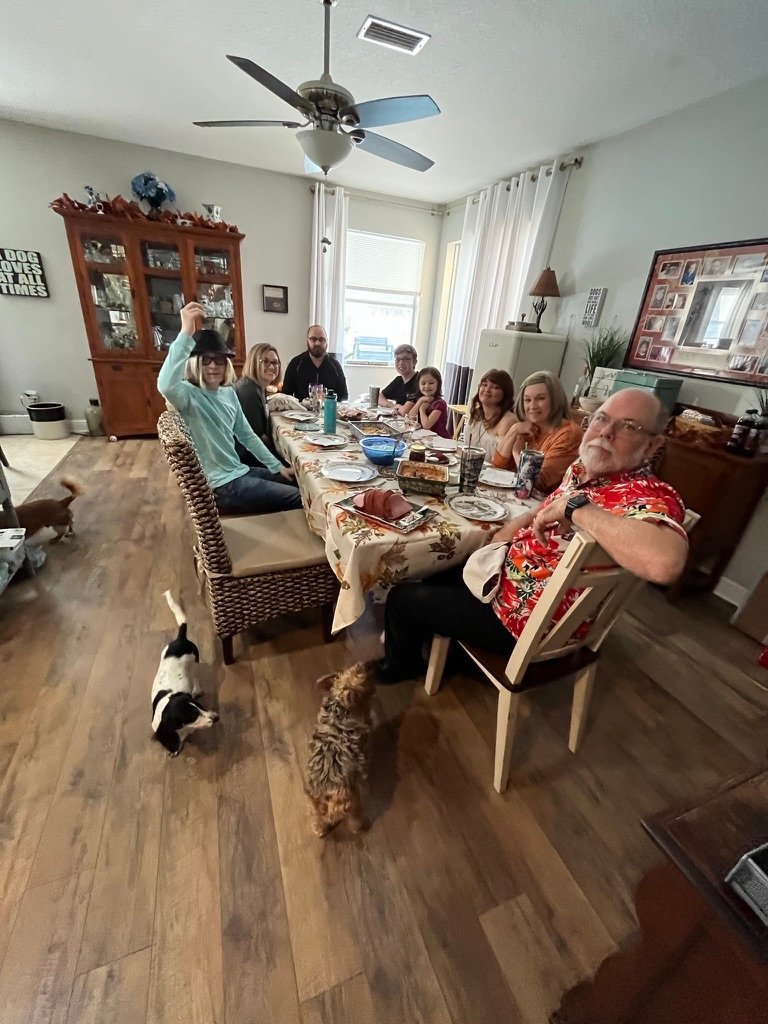
Every November, I’m reminded of how strange it is that gratitude and resentment can live so close to each other. We gather to eat, laugh, and remember where we come from, and in the background, someone is already bracing for political landmines. I hear people say they’re skipping Thanksgiving this year because a family member voted the wrong way. Or because an uncle watches the wrong news channel. Or because a cousin posted something infuriating on Facebook.
I have plenty of family members who don’t agree with me. Some think I’m naïve. Others think I’m too far left, and others think I’m too far right. And I’m sure a few think I’ve lost my mind entirely. But here’s the truth: I love them. They love me. None of that disappears because we see the world differently.
That doesn’t mean I surrender my convictions at the door. It doesn’t mean I won’t speak up when someone crosses a boundary. But disagreement doesn’t cancel love, unless we decide that it does.
And that’s the part people don’t want to hear. If you cut off a family member because they believe something you don’t, you’re not making a moral stand. You’re qualifying your love. You’re telling them that your affection is conditional on their behavior, their views, their vote, which is exactly the kind of conditionality we claim to despise in others.
I’ve had friends say they won’t sit at the table with their own parents or siblings because of politics. They tell themselves they’re being principled, but the message to the people who raised them is painfully clear: “You didn’t move. I did. And I’m going to punish you for it.”
That’s not courage. That’s not justice. It’s a quieter kind of selfishness, wrapped in virtue-language. And it reeks of the very cult-like mentality they think they’re resisting. When your identity becomes more important than your relationships, you’ve joined a tribe, not a moral movement.
The irony is that the best way to change someone’s mind has always been the same: listen. Not the performative kind of listening where you wait for your turn to lecture, but the real thing. Listen long enough to understand why they believe what they believe. Respond with logic that’s steady, not sharp. Add empathic understanding and remove all contempt. People rarely switch their views because someone shamed them.
Every family has its awkward conversations, its old wounds, its loud personalities. None of this is new. What is new is the idea that we’re entitled to a conflict-free, perfectly aligned table where no one ever says anything that challenges us. That fantasy is not Thanksgiving. It’s a curated ideology bubble.
I want my table to be full of people who don’t always get it right. Who don’t vote as I do. Who sometimes frustrate me. Who also love me in their flawed, human way. That’s what families are. And in the middle of all this noise, maybe that’s something worth keeping.
And here’s the part we often skip: I could be the one who’s wrong. Or at least the one who’s drifted too far into my own curated bubble. You can’t know you’ve wandered into an echo chamber if everyone around you sounds exactly like you. Sometimes the only thing that wakes us up is hearing a perspective that jars us a little. The disagreement itself becomes a grounding force, a reminder that the world is bigger than our feed.
If we can’t hold love steady across political differences, then we’ve lost something far more serious than an argument. We’ve lost the ability to be family. And that’s a much bigger problem than who carries the next election.