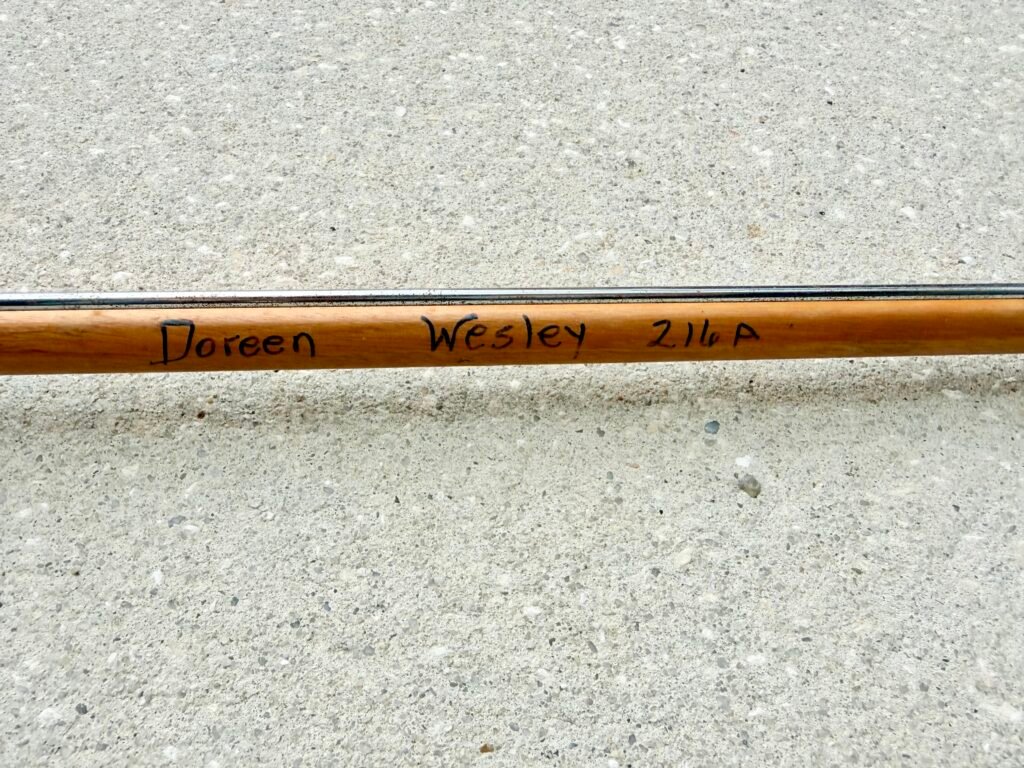
Today, in my garage, I picked up an old wooden grabber. It wasn’t much to look at; worn and twisted, but a name written across the wooden handle caught my eye. In faded ink, it read Doreen Wesley 216 A. My grandmother’s name. Her room number in the nursing home where she spent her last couple of years. Holding it in my hand, I was taken back to those visits in Louisville.
We had just moved back from Arizona at the time, and visiting Grandma was something we did as a family. My kids were teenagers then, old enough to understand but still too young to know what to do with the frailty of age. It was hard for them to see her thin, weak body and her dignity swallowed up in a place that felt more like an old hospital ward than a home. The air was heavy with the smell of urine and bleach, a sharp reminder of how far she was from her farmhouse kitchen or front porch, where she would sew or string beans from the garden.
And yet, despite the dim lighting and the sterile corridors, she still recognized me. Even when memory failed her, she called me by name. She knew who I was because I carried her story in mine. My first and middle names were chosen from her maiden name, Martin, and from my grandpa, Cortez. In me, she saw pieces of herself and maybe of the man she loved and cared for in Grandpa.
Grandma tried to keep her hands busy with sewing, though her eyesight was poor and her fingers stiff. She asked often about Grandpa, turning over those final days in her mind, seeking reassurance that she had cared for him well. Even in the fog of confusion, love of family and responsibility to one’s kin was what surfaced, and her recognition of me.
Looking back now, what strikes me most is how quickly the world strips away dignity when the body falters. My grandma had been the center of her family, the matriarch who held things together. Yet in that nursing home, she became just another patient in room 216 A, given a grabber with her name written on it so her belongings wouldn’t be lost. That small object, so ordinary, carried both her identity and the reality of her decline.
But the grabber also reminds me of something more. It teaches me that love has a way of cutting through confusion, of seeing what is true even when the mind grows dim. It reminds me that names matter because they hold stories, generations often folded into a single word. And it reminds me that even in frailty, the essence of a person doesn’t disappear. What mattered to her in those final days was not the loss of strength or memory but the assurance that she had loved well and been loved in return.
So that simple tool I found in my garage isn’t just wood and steel. It is a reminder that dignity should never be negotiable, that our elders deserve more than efficiency, and that the smallest tokens of a life, a name on a wooden stick, a half-finished piece of sewing, a remembered love, are often the ones that teach us the most.
Dr. Wesley